Master of Science in Occupational Safety and Health (MSc OSH)

Master of Science in Occupational Safety and Health (MSc OSH)

Overview 

The Master of Science in Occupational Safety and Health (MSc OSH) is a multidisciplinary postgraduate programme aimed at advancing knowledge and professional practice in workplace health and safety. This programme supports Malawi’s national efforts to improve occupational safety and health (OSH) systems and meets global standards defined by the ILO and WHO.

Occupational Safety and Health is concerned with promoting the highest standards of physical, mental, and social well-being among workers. It plays a critical role in improving labour productivity, strengthening regulatory frameworks, and creating safer working environments, especially as Malawi experiences growth in construction, manufacturing, and other industrial sectors.

Aim of the Programme

The MSc OSH programme is designed to build capacity in the occupational safety, health, and welfare sector. It also aims to equip OHS professionals with knowledge and skills to design, implement, and evaluate OSH policies. It further promotes safer, healthier, and more productive work environments across sectors

Programme Structure

The MSc OSH is a two-year (four-semester) programme delivered in a modular format:

Year 1 (semester 1 & 2)

  • Ten compulsory modules (Five per semester)
  • Each module carries a specific number of credits contributing to the required 120 credits for coursework completion
  • Module include:
        • Occupational Safety
        • Occupational Health
        • Occupational Toxicology
        • Ergonomics
        • Risk Management
        • Epidemiology and Statistics
        • Workplace Health and Safety Regulations
        • Management for Occupational Safety and Health
        • Professional Practice in OSH 
        • Research Methodology

    • Semester 3: Submission of a research proposal
    • Semester 4: Completion and submission of a dissertation
    • Research may involve experimental work, surveys, case studies, programme development, or modelling in OSH-related areas

    To graduate with a Master’s degree, a student must earn:

    • 120 credits from coursework
    • 60 credits from the dissertation
    • A minimum pass mark of 50% is required for the dissertation. Students must meet all academic requirements to graduate.

    Programme Duration and Extension

    • Standard Duration: 2 years (4 semesters)
    • Extension: Up to 2 additional semesters allowed upon application and payment of 50% of programme fees

    Programme Exit Options

    • Postgraduate Diploma in OSH: Awarded to students who complete at least 120 credits from coursework but do not proceed with the dissertation.
    • Master of Science in OSH: Awarded upon successful completion of 120 coursework credits and 60 dissertation credits.

    Minimum Entry Requirements

    • Applicants must have a Bachelor’s degree in a discipline related to occupational safety and health such as Environmental Health, Environmental Engineering, Chemistry or any relevant subject area, with an average grade of at least 50%.

    Required Documents

      • Proof of payment of the application fee (A non-refundable application fee of MK20,000.00 for Malawian applicants and US$60.00 for international applicants) – Completed PG programmes application form [insert link].
      • Certified copy of academic transcript/ academic record.
      • Certified copies of relevant certificates.
      • Reference letters from two (2) traceable referees (at least one academic).
      • Recent curriculum vitae.

      How to Apply

      • Applicants should submit their applications via email to: applicationspostgraduate@mubas.ac.mw 

      • Important Notes:

        • Postgraduate candidates can apply at any time during the academic year.
        • The closing date for receiving applications for the September intake is 30 May the same year whereas closing date for receiving applications for the March intake is 30 November the previous year

      Fees Structure

      • Successful applicants shall be required to pay the Malawi Kwacha equivalent of US$3,250.00 per year for domicile and SADC students and US$3,750.00 per year for other international students to cater for tuition, research project supervision and dissertation examination.

      Non-Programme Specific – Support Services

      Accommodation Assistance
      • Postgraduate programmes are offered on a non-residential basis. However, the University through the Office of the Director of Students and Student Affairs (DoSA) and the Postgraduate Office supports (PG) both local and international postgraduate students in securing suitable accommodation.
      Mental Health and Wellness
      • The university prioritizes student well-being by offering free psychological counselling through DoSA and the MUBAS Clinic. These services cover issues such as stress, anxiety, and university adjustment. In its effort to promote awareness and mental wellness each year, the university holds an annual Mental Health Day.
       Medical Coverage
      • All registered students are automatically enrolled in the UNIMED medical scheme, providing them with access to essential healthcare services.
      Orientation and Integration Support (for International Students)
        • International students benefit from a well-structured orientation programme organized by the PG. The programme provides several issues including, guidance on academic life, cultural adaptation, transportation, banking, and local living. Through the programme students interact with university personnel and receive help with registration, course selection, and use of learning platforms.
      Administrative and Visa Support

      • Through the office international student support, the university ensure that international student receive continuous support for visa applications, educational permits, and registration. The office also offer advice on local regulations to ease students’ transition and ensure policy compliance.


      Master of Science in Environmental Health (Msc Eh)

      Master of Science in Environmental Health (Msc Eh)

      Overview

      The Master of Science (MSc) in Environmental Health is a professionally postgraduate programme tailor designed to equip students with the advanced knowledge and skills necessary to address current and emerging environmental health challenges in Sub Saharan Africa (SSA). Environmental health is the assessment and management of environmental influences (e.g., chemical, physical, biological, social, and psychosocial factors) on human health. It takes a preventive approach to tackling disease and ill health. Environmental Health is a diverse profession covering aspects of physical and social science producing a graduate with a holistic understanding of preventive health, community development and environmental protection. The programme, guided by the five pillars of environmental health (food safety, occupational health and safety, community health, built environment, and pollution control as agreed by the Africa Academy for Environmental Health), which responds to all these key environmental health priorities. As such, the programme remains relevant to environmental health training in Malawi, Sub-Saharan Africa (SSA) and indeed at global level. The programme follows a modular block release mode of delivery ideal for professionals wishing to specialize in the field of environmental health while remaining in their work places active in the workforce.

      Aim of the Programme

      The MSc in Environmental Health aims to produce highly skilled graduates capable of addressing environmental health challenges across various sectors. Aligned with the Ministry of Health’s goal of creating a healthy Malawi free from environmental risks, the programme focuses on national priorities such as food safety, disease prevention, water and sanitation, and occupational health. The five pillars of environmental health from the Africa Academy for Environmental Health, the programme provides relevant postgraduate training to strengthen not only Malawi’s environmental health workforce and beyond but also support sustainable health development through research and professional practice.

      Programme Structure

      Year 1: (Semester 1 & 2)

        • Ten (10) core modules each carrying 12 credit points (total 120 credits)
        • Each module is delivered over four weeks:
          • 1 week of face-to-face intensive learning
          • 3 weeks of independent learning, assessments, and workplace/industry engagement
        • Students must pass all ten modules to proceed to Year 2
        • Modules include:
              • Epidemiology and Biostatistics
              • Environmental Pollution Control
              • Food Safety and Hygiene
              • Occupational Health and Safety
              • Environmental Health Nutrition
              • Global Health
              • Health and Behaviour Change Communication
              • Health Project Management, Monitoring and Evaluation
              • Water, Sanitation and Hygiene
              • Geographic Information Systems

          Year 2 (Semester 3 & 4)

          • Students undertake research in a relevant Environmental Health area
          • Activities include:
            • Developing and submitting a research proposal
            • Ethics approval from relevant boards
            • Participating in compulsory research seminars
            • Completing a dissertation (120 credit points)

          Programme Duration and Extension

          Duration
              • Full-time: 2 years (4 semesters)
              • Part-time: 3 years
            Extension
              • Students may apply for an extension of up to 12 months with payment of half the programme fee, subject to approval by the postgraduate committee.

            Programme Exit Options

              • Postgraduate Diploma: Awarded to students who complete 120 credits from coursework but do not proceed to dissertation.
              • Master’s Degree: Awarded upon successful completion of 240 credits (120 coursework + 120 dissertation).

            Application Information

            Who Can Apply?
            • Professionals from fields such as:
              • Environmental health
              • Public health
              • Occupational health and safety
              • Environmental sciences
              • Other related disciplines

            Minimum Entry Requirements

            Applicants must meet the following criteria:

                • Hold a Bachelor’s degree in Environmental Health, Public Health, or a related field from a recognized higher education institution.
                • Have an average grade of at least 50%, based on final year grades.
                • For applicants assessed using GPA, a minimum GPA of 2.0 is required.
                • Applicants who previously exited the programme with a Postgraduate Diploma (for reasons other than academic withdrawal) are eligible to re-join the second year to complete their dissertation, provided this is within three years of exiting the programme.

              Required Documents

                  • Proof of payment of the application fee (A non-refundable application fee of MK20,000.00 for Malawian applicants and US$60.00 for international applicants)
                  • Completed PG programmes application form [insert link].
                  • Certified copy of academic transcript/ academic record.
                  • Certified copies of relevant certificates.
                  • Reference letters from two (2) traceable referees (at least one academic).
                  • Recent curriculum vitae.

                How to Apply

                  • Applicants should submit their applications via email to: applicationspostgraduate@mubas.ac.mw 
                  • Important Notes:
                    • Postgraduate candidates can apply at any time during the academic year.
                    • The closing date for receiving applications for the September intake is 30 May the same year whereas closing date for receiving applications for the March intake is 30 November the previous year

                Fees Structure

                Successful applicants shall be required to pay the Malawi Kwacha equivalent of US$3,250.00 per year for domicile and SADC students and US$3,750.00 per year for other international students to cater for tuition, research project supervision and dissertation examination.

                DAAD Scholarship 

                TheMalawi University of Business and Applied Sciences (MUBAS), through its School of Science and Technology, floats call for applications for theMaster of Science in Environmental Health programme under the DAAD In-Country/In-Region Scholarships. The scholarship offers limited scholarship opportunities for both national and international applicants. Funded by the German Federal Ministry for Economic Cooperation and Development (BMZ), the scholarship supports postgraduate education primarily for university staff and public sector professionals.

                Key Details:

                    • Applicants must apply separately to both MUBAS and the DAAD portal
                    • DAAD application deadlines are usually in November
                    • Virtual info sessions are often held in October and November
                    • For latest calls and details, visit:

                    Scholarship Admission Requirements

                        • A Bachelor’s degree in Environmental Health, Public Health, or related field
                        • Above-average academic performance (Credit, Distinction or GPA ≥ 2.5)
                        • Degree obtained within the last 6 years
                        • Female and underprivileged applicants are encouraged to apply


                      MPhil/PhD in Environmental Health

                      MPhil/PhD in Environmental Health


                      Admission criteria


                      Candidates seeking admission to the first year of the PhD in Environmental Health must hold a Master’s degree in Environmental Health or a related field. Those applying for MPhil should have a Bachelor of Science Degree or any related field with experience in conducting independent research. Additional admission requirements are outlined in the GPRH or the advertisement for postgraduate programs at MUBAS.


                      Programme structure


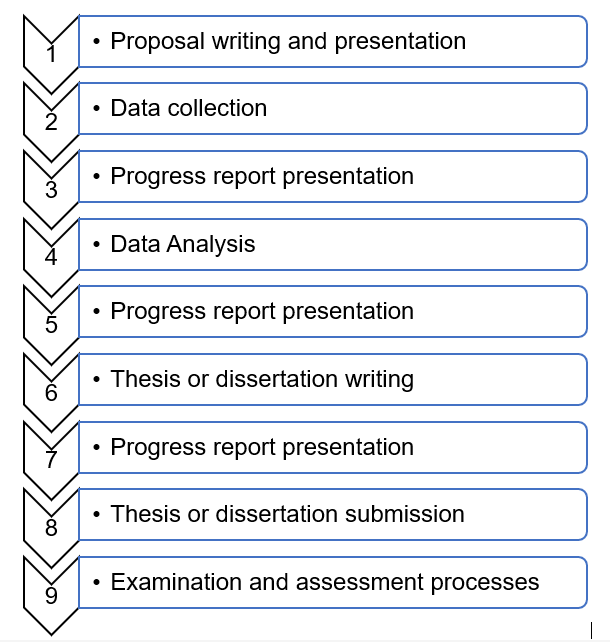
                      The PhD is awarded to scholars who have conducted supervised, original research that is deemed to have made a significant contribution to the field of environmental health. This program is fully research-based. All students are enrolled in the PhD program from the first year and are assigned both a primary and secondary supervisor, with the division of responsibilities outlined in the Postgraduate Handbook. In the first year, students may audit certain modules, including Research Methodology at the Master’s level, to earn 60 credits for academic enrichment, which can assist in proposal development and the research process. The thesis itself contributes 360 credits toward the PhD in Environmental Health. The key stages of the research project are illustrated in Figure 1.


                      Figure 1: Research Project Stages


                       Preparation for the Dissertation


                      Students are required to take Research Methodology in their first year to prepare for their research work. The concepts learned in this course lead to the development of a research proposal, which must be defended before data collection begins. For detailed guidelines on dissertation preparation, please refer to the Postgraduate Handbook.


                      Programme exits


                      Upon successful completion of the program, students will be awarded a PhD in Environmental Health. To earn the degree, a candidate must accumulate a total of 360 credits. If a candidate is unable to satisfactorily complete the PhD requirements for any reason, they may be awarded an MPhil in Environmental Health, provided they meet the conditions for that award.


                      Master of Science in Environmental Health

                      Master of Science in Environmental Health


                      Admission criteria


                      The following shall be eligible for admission into the Master of Science in Environmental programme:


                      The Master of Science in Environmental Health programme shall admit holders of a bachelor’s degree from any recognized institution of higher learning in Environmental Health, Public Health or in any other related field with a minimum average grade of 50%. The minimum average shall be computed based on final year grades. For applicants with grade point average (GPA) grades, the requirement shall be a holder of a bachelor’s degree from any recognized institution of higher learning in Environmental Health, Public Health or any other related field with a minimum GPA of 2.5 on 5.0 GPA scale and 2.25 on a 4.0 GPA scale.


                      Programme Structure


                      The programme is modular with each module being of 12-credit point value. Each credit represents 10 hours of student learning, endeavour and assessment. All modules are examinable and a student should pass all modules. Each student must complete ten compulsory modules, and must obtain at least a total of 120 credit points to fulfil the coursework requirements for the programme.The student must also attend compulsory research methods seminars to be organised by the department.


                      Preparation for the Dissertation


                      During the second semester of the first year, one of the modules is Research Methods in which students are required to undertake concept and proposal development. The concept culminates into a research proposal which is supposed to be defended before data collection and analysis. There are a number of workshops covering different areas such as research ethics, clarification of research methods, statistics, problem identification, concept writing and proposal development.


                      Programme exits


                      Postgraduate diploma


                      A student who has been credited with at least 120 credits at Postgraduate Level, and who cannot progress further on the programme, will be awarded a Postgraduate Diploma in Environmental Health.


                      Master’s Degree


                      A student, who has been credited with at least 240 credits at Postgraduate Level comprising 120 credits from coursework and 120 credits from dissertation, will be awarded a Master of Science Degree in Environmental Health


                      Bachelor of Science in Environmental Health

                      Bachelor of Science in Environmental Health

                      Programme Structure

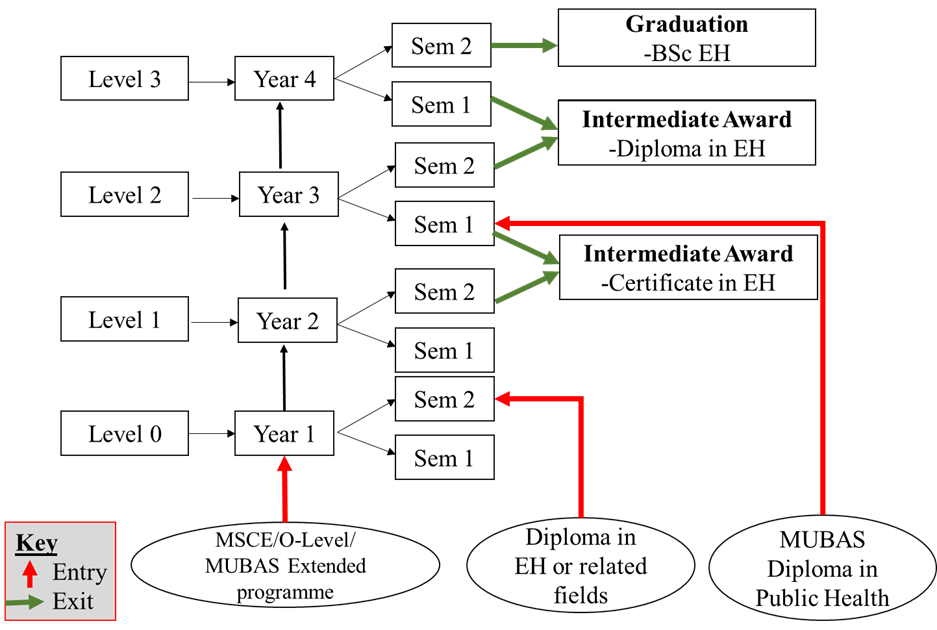
                      Normal Entry

                      A candidate with MSCE, ‘O’ Level or equivalent may join the programme at the beginning year 1. The candidate must have at leasr six credits including English, Mathematics, Biology, Physics and Chemistry.

                      Mature Entry

                      1. A candidate with MSCE, ‘O’ Level or equivalent, field work experience and a relevant qualification from a recognized institution, may join the programme at the beginning of year 2 (Semester 1).

                      1. A candidate with MSCE, ‘O’ Level or equivalent, field work experience and a diploma in Public Health obtained from MUBAS or similar qualification from recognized institution, may join the programme at the beginning of year 3 (Semester 1).


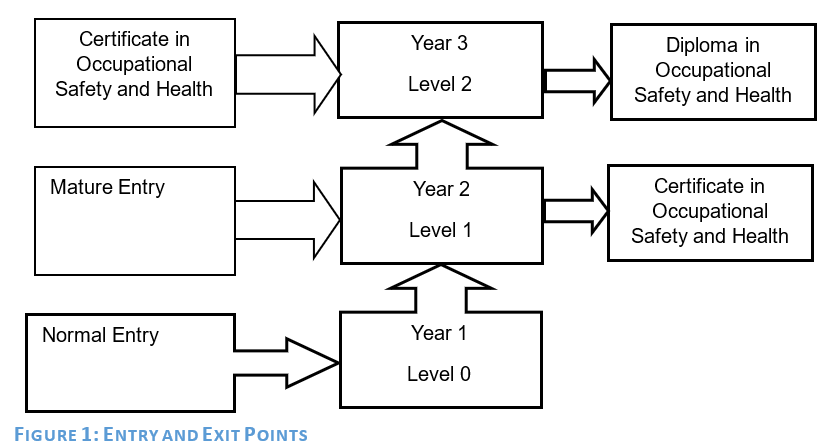
                      Figure 1: Triple-Entry and Triple-Exit Structure of BSc Environmental Health

                      Selection Criteria

                      Selection of applicants will be based upon consideration of an individual’s academic qualification, and, in case of mature entry candidates, work experience. Entry to the programme will be open to applicants who conform to the following criteria:

                      Normal Entry Candidate:

                      1. Six MSCE/O-Level credits including English, Mathematics, Biology, Physics and Chemistry.
                      2. Successful completion of MUBAS extended program

                      Mature Entry Candidate:

                      1. Diploma in Environmental Health from Malawi College of Health Sciences, or Diploma in Public Health from University of Malawi
                      2. MSCE/O-Level with at least credit passes in English, Mathematics, Biology, Physics and Chemistry or General Science.
                      3. At least 2 years relevant work experience

                      Programme Exits

                      Intermediate Award: Certificate in Environmental Health

                      A student who has accumulated at least 240 credits, and who cannot progress further on the programme, will be awarded an Intermediate Award: Certificate in Environmental Health (Figure 1).

                      Intermediate Award: Diploma in Environmental Health

                      A student who has accumulated at least 360 credits, and who cannot progress further on the programme, will be awarded an Intermediate Award: Diploma in Environmental Health (Figure 1).

                      Bachelor of Science Degree in Environmental Health

                      A student, who has accumulated at least 480 credits will be awarded a Bachelor of Science Degree in Environmental Health (Figure 1).

                      Programme Delivery

                      The programme will be delivered through the normal face to face MUBAS semester system.


                      Master of Science in Occupational Safety and Health

                      Master of Science in Occupational Safety and Health


                      Admission criteria


                      The following shall be eligible for admission into the Master of Science in Occupational Safet and Health programme:


                      The Master of Science in Occupational Safety and Health programme shall admit holders of a bachelor’s degree from any recognized institution of higher learning in Occupational Safety and Health, Environmental Health, Public Health or in any other related field with a minimum average grade of 50%. The minimum average shall be computed based on final year grades. For applicants with grade point average (GPA) grades, the requirement shall be a holder of a bachelor’s degree from any recognized institution of higher learning in Occupational Safety and Health, Environmental Health, Public Health or any other related field with a minimum GPA of 2.5 on 5.0 GPA scale and 2.25 on a 4.0 GPA scale.


                      Programme Structure


                      The programme comprises ten compulsory modules. Five of these modules will be offered in semester 1, and the other five in semester 2. A dissertation will be conducted in semester 3 and 4.  A student must complete all the ten modules   and must obtain at least a total of 180 credit points to fulfill the requirements for the award of a Master of Science in Occupational Safety and Health degree. One credit point represents the amount of learning achieved through a notional 10 hours of learning time. Notional hours include everything a student must do to achieve the intended learning outcomes in a qualification.


                      In addition, students are required to submit a research proposal at the beginning of the third semester. A complete dissertation will be submitted at the end of the fourth semester. The research can take the form of experimental work, survey, case studies, programme development, and modeling in any OSH related area of interest.


                      Programme Exits


                      The programme has two exits: postgraduate diploma and MSc depending on completion of modules and dissertation. A student, who has been credited with at least 120 credits from course work and cannot progress further on the programme, will be awarded a Postgraduate Diploma. A student, who has been credited with at least 120 credits from course work and at least 60 credits from dissertation, will be awarded a Master’s Degree in OSH.


                      Support for Students and their Learning


                      The programme will make use of existing teaching and learning resources outlined below


                      • Lecture rooms, laboratories, library, and internet facilities. MUBAS Library subscribes to a number of online databases enabling the students of the programme to access to online or e-journals.

                      • Student Information Management System which will be used to manage the administrative and academic processes of the programme.

                      • In terms of social services, MUBAS and College of Medine are well positioned. It is within walking distance to social amenities e.g. manufacturing companies, shopping mall, dispensaries, banks, highway, and sports facilities.

                      • WASHTED, under the Institutional Capacity Grant from the National Commission for Science and Technology (NCST), has acquired some equipment which will be used for   practical teaching of some modules in this programme.

                      • Students shall be supported through consultations, tutorials and presentations.


                      Bachelor Of Science In Occupational Safety And Health

                      Bachelor Of Science In Occupational Safety And Health


                      Admission Criteria


                      Normal Entry


                      A candidate with MSCE, ‘O’ Level or equivalent may join the programme at the beginning of year 1 or level 0. These should have at least six credits including English, Mathematics, Biology, Physics and Chemistry or Physical Science


                      Mature Entry


                      1. A candidate with MSCE, ‘O’ Level or equivalent, field work experience and a qualification from a recognized institution, may join the programme at the beginning of year 2 (Semester 1).

                      2. A candidate with MSCE, ‘O’ Level or equivalent and a MUBAS diploma in OSH may join the programme at the beginning of year 3 (Semester 1).


                       Programme Structure


                      The School of Science and Technology, Department of Public and Environmental Health Sciences at MUBAS proposes to introduce a BSc in Occupational Safety and Health (BOSH) programme. Occupational Safety and Health deals with safeguarding and promoting the health and welfare of all workers which include the following priority areas;


                      1. Improving capacity for occupational safety and health management.

                      2. Strengthening legal framework and infrastructure on occupational safety and health

                      3. Improving occupational safety and health information and documentation

                      4. Improving occupational safety and health promotion and safety and health culture

                      5. Improving the mainstreaming of HIV/AIDS and occupational TB management.


                      BOSH students may be employed as Occupational Safety and Health officers and OSH inspectors. They research, develop, control and provide advice on OSH. They coordinate risk assessment procedures that provide guidance on how risks should be controlled in a workplace. They promote safety and health principles through enforcement of OSH Act and regulations.


                      The programme will enable students to gain skills and competences in the design, implementation and evaluation of occupational safety and health management systems. Furthermore, the programme includes an element of self-directed learning and reflective practice that provide an experience of independent knowledge acquisition and their application in problem solving activities.


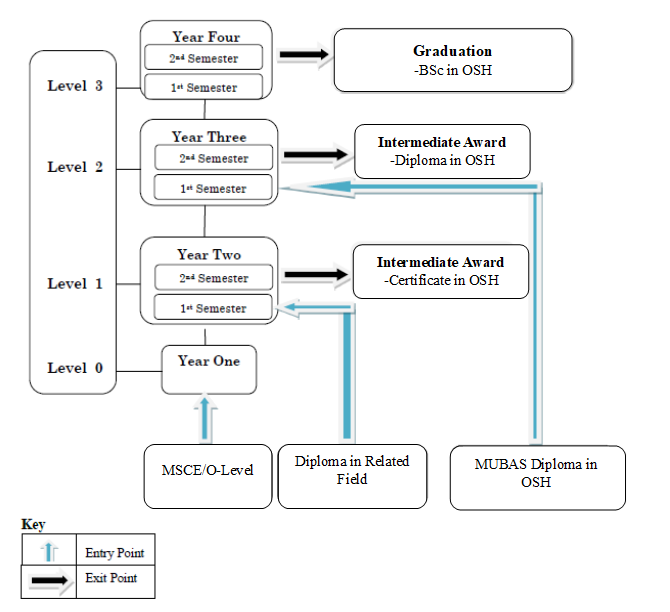
                      Students will be able to join the programme at level 0, level 1 and level 2 depending on previous qualifications and experience. It is also possible for a student to exit the programme and get an appropriate competence-level award.


                      Figure 1: Triple-Entry and Triple-Exit Structure of BSc in Occupational Safety and Health


                      Programme Exits


                      Intermediate Award: Certificate in OSH


                      A student who has been credited with at least 240 credits, and who cannot progress further on the programme, will be awarded an Intermediate Award: Certificate in OSH.


                      Intermediate Award: Diploma in OSH


                      A student who has been credited with at least 360 credits, and who cannot progress further on the programme, will be awarded an Intermediate Award: Diploma in OSH.


                      Bachelor of Science Degree in OSH


                      A student, who has been credited with at least 480 credits will be awarded a Bachelor of Science Degree in OSH (Figure 1).


                      Diploma In Occupational Safety And Health

                      Diploma In Occupational Safety And Health

                      Admission Criteria

                      The admission requirement into the Dip OSH programme shall be:

                      Normal entry

                      1. MSCE or O level with four credits including English, Mathematics, Biology, Chemistry and Physics or General Science.; or
                      2. A-Level with at least a C in English, Biology, Chemistry or Physics.

                      Mature entry

                      1. MSCE with four credits including English, Physical Science or General Science and Biology
                      2. Minimum of two years working experience in related field and
                      3. Any certificate in related field


                      Programme Structure

                      The programme will run for a period of three years (six semesters). The minimum number of credits a student may take per semester is 60. Thus, the minimum total number of credits required in the entire programme is 360 in semester two of year two students will go on attachment.


                      MPhil/PhD in Public Health Engineering

                      MPhil/PhD in Public Health Engineering


                      Admission Criteria


                      Candidates to be admitted into the first year of the PhD in Public Health Engineering should possess a Master’s degree in Public Health Engineering any related programme. Those applying for MPhil should have a BSc in Environmental Health, Public Health or Engineering related field from accredited institution. The other requirements are as stipulated in the GPRH or advert for postgraduate programmes at MUBAS.


                      Programme Structure


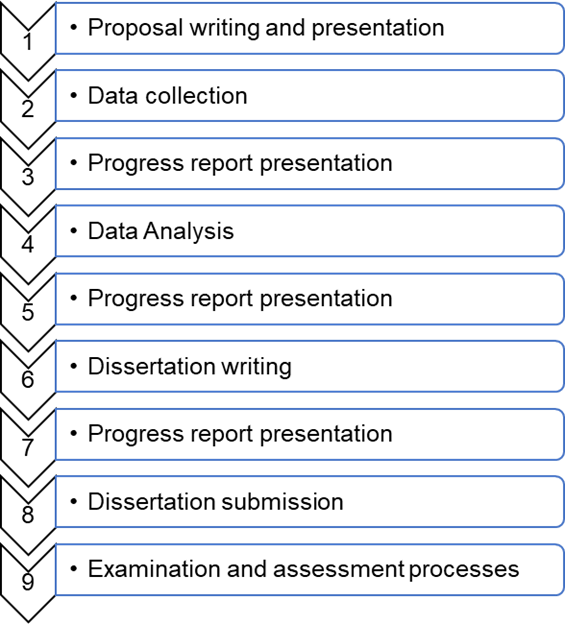
                      PhD is awarded to scholars who have carried out supervised original research work that has been judged to have significantly contributed to the body of knowledge in public health engineering. The PhD student needs a thesis to be presented in a logical and scholarly manner and must convince their examiners that they have fully grasped all the concepts of public health engineering within which the subject of their thesis falls. The candidate will develop the qualities and abilities to make informed judgments on intricate issues in public health engineering and innovation in solving respective problems. This is a full research-based degree programme. All students are registered for PhD programme in the first year, and assigned first and second supervisors. The exact division of responsibility between the two supervisors is stipulated in the Postgraduate Handbook. In the first year, the student will take some modules including Engineering for Public Health and Research Methodology for self-academic enrichment that could help him/her in proposal development and the research stages. The thesis contributes 360 credits for the award of a PhD in Public Health Engineering. The research project stages are presented in Figure 1.


                      Figure 1: Research Project Stages


                      Preparation for the Thesis


                      The students are compelled to learn Research Methodology in the first year in preparations for their research work. The concepts learnt in Research Methodology culminate into a research proposal which is supposed to be defended prior to data collection. Refer to the guidelines in Postgraduate Handbook for details of thesis preparations.


                      Programme Exits


                      On successful completion of the programme, students will be awarded a PhD in Public Health Engineering. A candidate has to accumulate a total of 360 credits. If the candidate has not completed the studies satisfactorily, due to various reasons, the candidate may be awarded an MPhil in Public Health Engineering upon satisfying conditions of the award.


                      Diploma In Public Health

                      Diploma In Public Health

                      Offered by the

                      SCHOOL OF SCIENCE AND TECHNOLOGY, DEPARTMENT OF PUBLIC AND ENVIORNMENTAL HEALTH SCIENCES AND ABMA THROUGH INSTITUTE OF CONTINUING EDUCATION

                      Programme Structure

                      The DPH is designed to combine theory and practice in the field of public health. The programme is divided into three parts: continuous assessment, examination and practicum. The curriculum has been structured into modules to be delivered in six semesters over a three-year period.

                      Admission Criteria

                      MUBAS and ABMA subscribe to the Multiple-Entry-Multiple-Exit philosophy. This philosophy allows learners to join and exit the programme at different stages while recognising the type of learning that they have acquired.

                      Entry Requirements

                      The programme has two entry points:

                      Generic entry

                      A candidate with MSCE, O level or its equivalent shall join the programme in Year 1.

                      Mature entry

                      A candidate with MSCE, O level or its equivalent industrial experience and a Certificate in Public Health or equivalent qualification from recognized institutions shall join the programme in Year 2.

                      Selection Criteria

                      Selection of applicants will be based on consideration of individual achievements and in the case of mature candidates work experience. Entry into the programme will be open to candidates who conform to the following criteria

                      Normal entry candidates

                      Candidates to be considered for enrolment in first year must have:

                      At least four credits at MSCE or its equivalent including English, mathematics, physical science (physics and chemistry), and biology.

                      Mature entry candidates

                      At least four credits at MSCE or its equivalent including English mathematics, physical science (physics and chemistry), and biology. In addition, they should possess a Certificate in a health-related programme from a recognised institution and two years’ work experience.

                      Mature candidates will be enrolled at year 2.

                      Exit Points

                      • Candidates who have completed the first two years (240 credits), and are not proceeding to year 3 will be awarded a Certificate in Public Health or
                      • Upon successful completion of all requirements for Year 3 (minimum of 360 credits), the candidate will be awarded a Diploma in Public Health 

                        Medium of instruction:    English

                        Attendance: Full time, residential/part time/evening/ block release, weekend and non-residential. The initial plan is to offer the programme through full time (face-to-face) mode of delivery at MUBAS main campus in Blantyre and incorporate other modes of delivery including ODeL in subsequent years of implementation.